
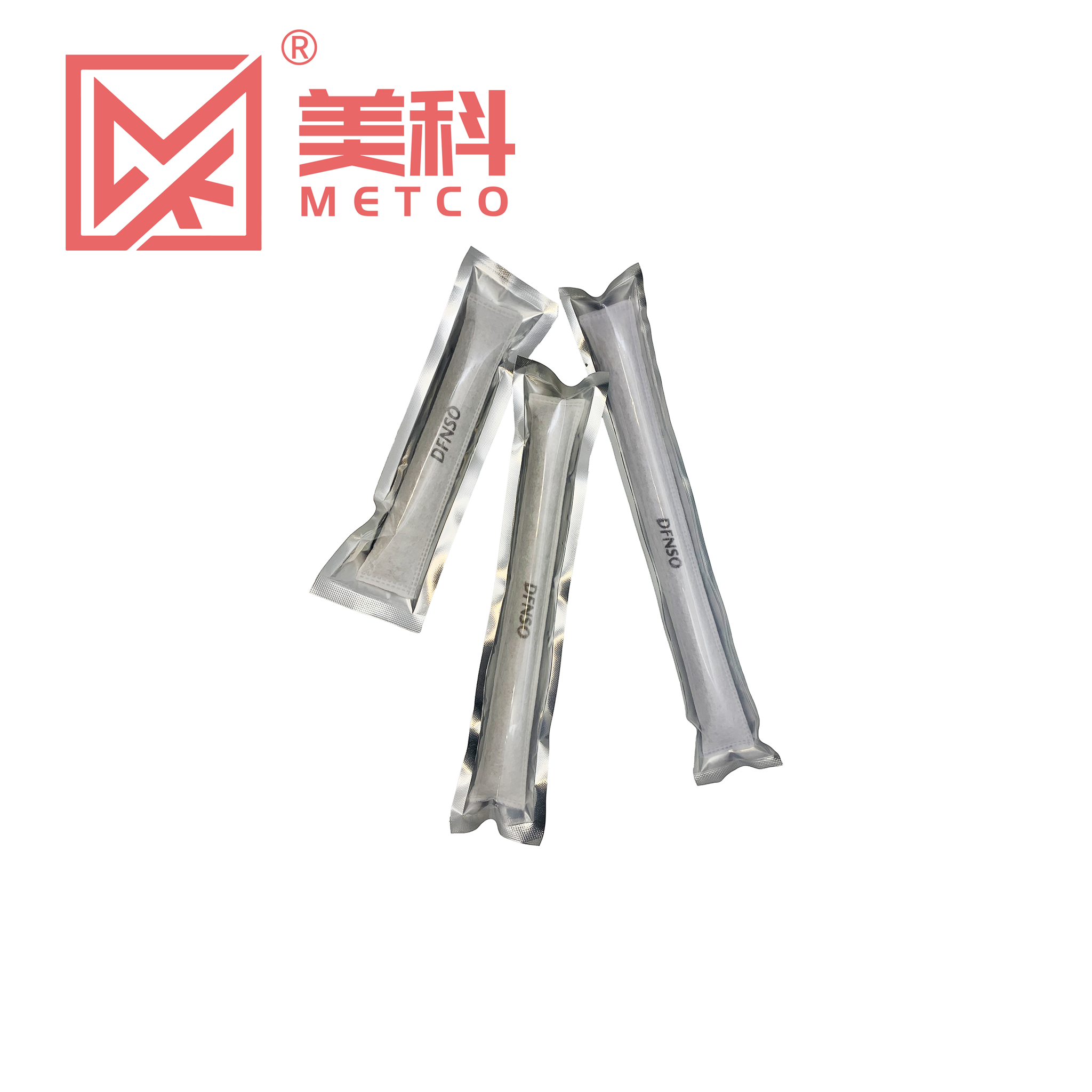
Receiver Drier Bag / Accumulator Desiccant
Free shipping on orders over $50!
- Satisfaction Guaranteed
- No Hassle Refunds
- Secure Payments
2. Market Position of Desiccant Bags in the Auto Parts Industry
The desiccant bag acts as the “final line of defense” within the automotive air conditioning (A/C) circulation system. Its role is indispensable for the following reasons:
- Core Functionality: Its primary mission is moisture adsorption and debris filtration. Automotive refrigerants (such as R134a or R1234yf) are extremely sensitive to water. Even trace amounts of moisture can cause “ice plugging” at the expansion valve and react with the refrigerant to form acidic substances that corrode the entire pipeline.
- System Protector: It is the “guardian” of the A/C compressor. If a desiccant bag fails, metallic shavings or sludge within the loop can migrate directly into the compressor, leading to seizure or catastrophic mechanical failure.
- High-Frequency Maintenance Item: In the Independent Aftermarket (IAM), industry standards dictate that the desiccant bag must be replaced whenever the A/C loop is opened (e.g., during the replacement of a condenser, compressor, or hose). This mandatory replacement protocol ensures a steady and robust demand in the service market.
2. Global Market Development Trends
The global market for desiccant bags is undergoing significant structural shifts driven by automotive evolution:
A. Evolution from “External” to “Integrated” Design
Traditional receiver driers were typically standalone metal canisters. Modern passenger vehicles, however, increasingly utilize integrated desiccant bags. These are inserted directly into the receiver pipe on the side of the condenser. This design is more lightweight and cost-effective, but it demands higher temperature resistance and pressure durability from the bag’s packaging materials (such as non-woven or nylon fabrics).
B. New Growth from Electric Vehicles (EVs)
- Complexity of Thermal Management: Unlike internal combustion engines, EVs require refrigerant loops not only for cabin cooling but also for Battery Thermal Management (BTM). This increased complexity demands higher refrigerant purity and stricter moisture control, leading to a higher volume of desiccant required per vehicle.
- Refrigerant Transition: As global environmental regulations phase out R134a in favor of R1234yf, the industry is shifting toward high-performance molecular sieves. These new desiccants offer optimized adsorption rates and chemical stability specifically tailored for next-generation refrigerants.
C. Competitive Landscape
- Global Tier-1 Integration: The market is dominated by major A/C system integrators—such as Denso, Mahle, Valeo, and Hanon Systems—alongside specialized filtration and drying component manufacturers.
- Rise of Chinese Manufacturers: As the world’s largest automotive parts production hub, China has achieved significant advantages in both molecular sieve raw materials and desiccant bag assembly. Chinese suppliers are capturing an increasing share of the global Aftermarket (IAM) due to high cost-efficiency and manufacturing scale.
评价
目前还没有评价